How to Organize a Small Closet (2026 Guide)
Small closets aren't a problem to solve once. They're a system to maintain. The reason your wardrobe looks chaotic two weeks after every reorganisation isn't that you bought the wrong baskets; it's that the system doesn't match how you actually get dressed. This guide walks through a method that holds up.
Start by emptying everything
Before you buy a single hanger or storage box, take everything out. Yes, everything. Pile it on the bed.
This step is non-negotiable for two reasons. First, you can't see what you own when it's compressed onto a rod; you'll under-count by 30–50%. Second, an empty closet shows you the real space: where the rod sags, which shelves are too deep, where light doesn't reach. You can't design around constraints you can't see.
Sort into four piles, not three
The classic keep / donate / bin split is too coarse. Use four:
- Keep: wear regularly, fits well, in good repair
- Repair / alter: would wear if the hem, button, or fit were fixed
- Donate / sell: fits, in good condition, but not your style anymore
- Bin / recycle: damaged beyond repair (most councils now accept textiles in kerbside recycling)
The "repair" pile is where most small closets bleed space. A bag of "I'll fix it someday" sits in your closet for years. Set a deadline: anything not repaired within 30 days joins the donate pile.
Zone the closet by frequency, not by category
Most advice tells you to group by garment type: all shirts together, all trousers together. That's fine, but it ignores the real bottleneck: how often you reach for something.
Better approach:
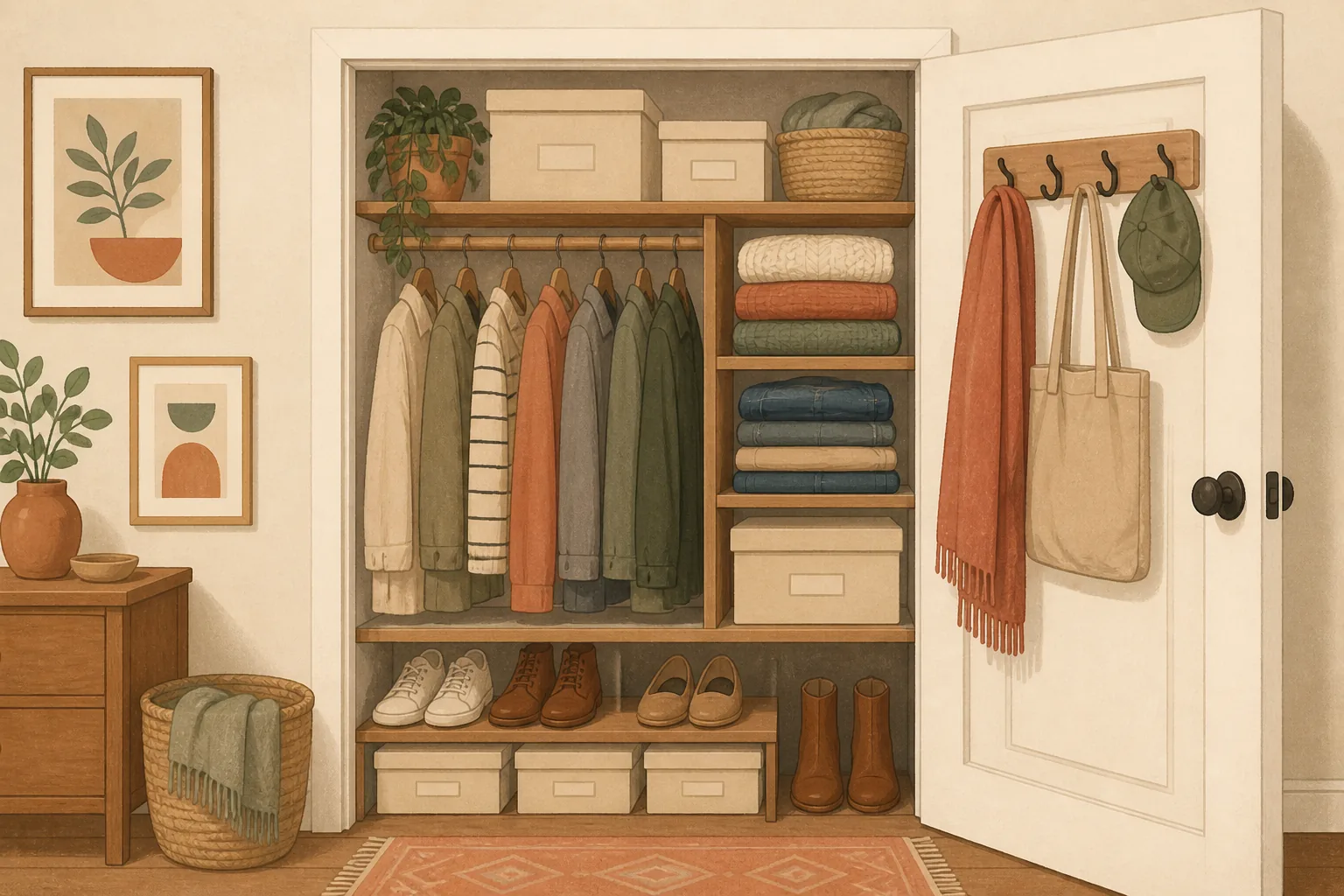
- Eye-level zone: what you wear every week. Workwear, go-to jeans, daily layers.
- Above eye-level: seasonal or occasional. Coats out of season, formalwear.
- Below eye-level: bulky items and storage. Shoes, gym kit, suitcases.
Within each zone, then group by category. This way the things you reach for daily are the easiest to grab, and you stop knocking your "interview blazer" off its hanger every morning.
Pick storage that matches the constraint
Small closets have one of three constraints; diagnose yours before buying anything:
| Constraint | Symptom | Solution |
|---|---|---|
| Vertical space wasted | Big gap above the rod | Add a second rod or stacked shelves |
| Shelf depth wasted | Items lost at the back | Pull-out drawers or front-loading bins |
| Door/wall unused | Closed door is dead space | Over-door hooks, slim wall pegs |
Don't buy storage to make a closet "look organised." Buy it to remove a specific friction.
The hanger rule that actually saves space
Switch every hanger to the same thin, flocked style. Not because they look nicer, but because uniform hanger thickness alone reclaims roughly 40% of rod space, and clothes stop slipping off. It's the single highest-ROI purchase for a small closet.
Bonus rule: turn every hanger backwards on January 1st. After a year, anything still backwards hasn't been worn. That's your next donate pile.
Track what you actually own
The deepest reason small closets feel cluttered isn't physical; it's cognitive. You can't picture what's in there, so you keep buying duplicates and forgetting items at the back. A digital closet solves this.
Snap a photo of each item once. Now you can browse your wardrobe on your phone, see everything you own at a glance, and (with Closet DJ) get AI-generated outfit suggestions from clothes you already have. The cleanup effect is immediate: when you can see you already own three black tops, you stop buying a fourth.
This is also the part most "closet organisation" advice skips, because until recently it was tedious. AI photo import means it now takes minutes, not hours.
Maintain it in 5 minutes a week
A closet stays organised through one habit: a weekly 5-minute reset.
- Re-hang anything that fell
- Move new arrivals into the eye-level zone
- Drop laundry into the right basket (clean / dirty / dry-clean)
That's it. No big seasonal overhauls. The system carries itself if you give it five minutes.
Frequently asked questions
What's the fastest way to organise a small closet in one day?
Empty everything, sort into the four piles above, donate the discard pile the same day so it can't migrate back, then re-hang only the keep pile by frequency zone. A morning is enough for most small closets.
Should I store clothes by colour or by category?
By category first (so you can find the type of item you need), and within each category, by colour (because that's what your eye looks for once you know what kind of garment you want).
How do I stop my small closet from getting cluttered again?
Two rules: one in, one out (a new shirt = an old shirt leaves), and a weekly five-minute reset. Both work because they're small enough to actually do.
Is a digital closet app worth it for a small wardrobe?
Especially for small wardrobes, yes. The smaller your closet, the more you need every item to earn its space, and a digital catalogue surfaces forgotten pieces and prevents duplicate purchases.
If you want help building outfits from what's already in your closet, Closet DJ is free to start: snap your clothes, and the AI does the rest.
Ready to remix your closet?
Try Closet DJ free. Organise your wardrobe and let AI build outfits from what you already own.
Recevez les nouveaux articles par e-mail
Un e-mail par nouvel article, écrit par l'équipe Closet DJ. Pas de spam, désabonnement à tout moment.