Cost Per Wear: The Simple Math That Makes Every Shopping Decision Easy

A price tag answers a question nobody asked: what does this cost once? The question you actually care about is what it costs every time you wear it, and those two numbers can be wildly different. A €180 coat you wear three times a week all winter is cheaper, in the only sense that matters, than a €30 top that never leaves its hanger.
Cost per wear is the one piece of wardrobe maths that changes shopping behaviour immediately, because it is very hard to argue with. Here is the formula, the test to run before you buy, and the four places where the number quietly lies to you.
The formula
Cost per wear is the price divided by the number of times you wear the item.
That is the entire calculation. What makes it useful is not the arithmetic, it is what happens when you run it on things you already own:
- €180 wool coat, worn three times a week for four winter months, kept five years: roughly 255 wears, about €0.71 per wear.
- €90 trainers, worn four times a week for two years: roughly 416 wears, about €0.22 per wear.
- €30 going-out top, worn twice: €15 per wear.
- €250 wedding-guest dress, worn once: €250 per wear.
Run this on ten items in your closet and the pattern is always the same. The expensive things are rarely the problem. The problem is the medium-priced pile of items bought for a version of your life that does not happen very often.
Wears matter more than price
Notice which half of the formula does the heavy lifting. Price varies by maybe a factor of ten across a normal wardrobe. Wear counts vary by a factor of hundreds. A garment worn 300 times and a garment worn twice are not in the same category of purchase, whatever they cost.
This is why "is it worth it?" is the wrong question in a shop. The right question is "how often does my life actually call for this?" Most wardrobes are already carrying the evidence: the same 20 percent of items get worn on repeat, a pattern we worked through in how many clothes do you actually need. Cost per wear just puts a price on that imbalance.
The break-even test, before you buy
Do this in the shop, before anything reaches the basket.
- Pick your threshold. A number you would be happy paying each time you wear something. For everyday clothes, €1 to €2 is a reasonable bar.
- Divide the price by the threshold. That gives you the number of wears you need. A €120 jacket at a €2 threshold needs 60 wears.
- Convert that into real time. Sixty wears is roughly two winters of twice-weekly use. Five years of a once-a-month occasion.
- Answer honestly. Do you genuinely have 60 occasions for this, in weather you get, in a life you actually live?
The power of this test is that it converts a question you always answer yes to ("do I want it?") into one you often answer no to ("will I wear this 60 times?"). It also quietly reframes expensive purchases. A well-made coat that clears the bar in one season is an easy yes. A €45 shirt for an occasion type you get twice a year is an easy no, and it was never the coat that was the extravagance.
The four places the math lies
Cost per wear is a good instinct and a bad law. Watch for these.
It ignores upkeep. A dry-clean-only blazer at €12 a clean adds real money to every few wears. Add care costs to the numerator, or at least favour items you can wash at home. Our laundry care symbols guide is genuinely a cost document if you read it that way.
It rewards owning nothing. Taken literally, the lowest cost per wear is always the thing already in your closet. As a bias that is healthy. As a rule it traps you into wearing clothes that no longer fit your body, your job, or your climate.
It flatters sunk costs. Once an item is bought, its cost per wear can only ever fall, which makes an excellent excuse for keeping something you should sell or pass on. The money is already gone. The only live question is whether the item earns its hanger space now.
It cannot price joy. A dress worn once at a wedding you loved is not a failed purchase. Some clothes are bought for a moment, not a rotation. Just be honest about which category you are shopping in.
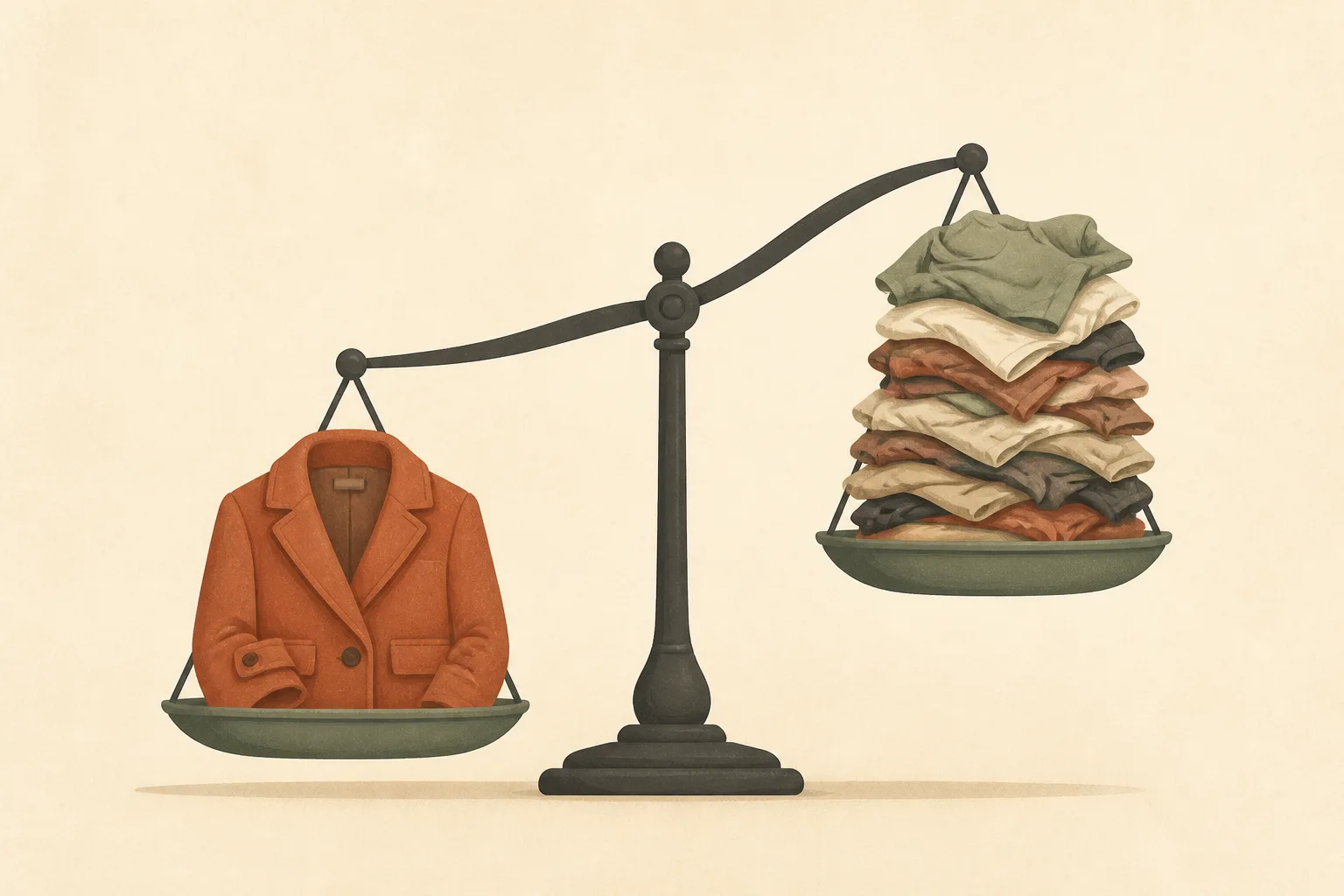
There is a related trap at the cheap end. A €15 top that loses its shape after six washes costs €2.50 per wear, which is worse than a €60 shirt worn a hundred times. Low prices do not automatically produce low cost per wear. Durability is half the equation, and it is the half the price tag never shows you.
Making it work without a spreadsheet
The formula is trivial. Getting real wear counts is the hard part, and estimates are where this method usually dies, because everybody overestimates how often they wear the things they like owning.
Four habits that make it survive contact with real life:
- Count wears, do not guess them. One tap when you wear something beats a memory reconstruction three months later.
- Set thresholds per category. Coats, shoes and jeans should reach very low numbers. Occasion wear never will, and that is fine.
- Review at the season switch. When you rotate the closet is the natural audit point, and you are handling every item anyway. The seasonal wardrobe switch is the ideal moment to spot the items sitting at zero.
- Use it forwards, not backwards. It is a purchase filter first and a decluttering tool second. Judging past buys is mostly just an expensive way to feel bad.
Let the software count
Everything here works with a notepad. The counting does not, which is exactly the part worth automating.
Closet DJ tracks every wear as you plan and log outfits, so the cost per wear of each item is a number you can look up rather than reconstruct. Add what you paid when you add the item, and your closet stats turn into a shopping filter: your best value pieces, your dead weight, and the categories where you keep buying things you do not wear. Pair that with a deliberately small core wardrobe, like the one in our capsule wardrobe checklist, and the numbers get better on their own.
Frequently asked questions
What is cost per wear?
Cost per wear is what a garment costs you each time you actually wear it: the purchase price divided by the total number of wears. It is a way of judging value over the life of an item instead of at the till, and it usually reverses the ranking you get from price alone.
How do you calculate cost per wear?
Divide the price by the number of times you have worn the item. For an item you are thinking of buying, divide the price by the number of wears you realistically expect over its lifetime. Include cleaning and repair costs in the price if the item needs professional care, since that money is part of what it costs to keep wearing it.
What is a good cost per wear?
There is no universal figure, but a practical target for everyday clothes is under €1 to €2 per wear. Coats, shoes and jeans should comfortably beat that. Occasion wear rarely will, so judge it against the occasion instead: a single-use item is a fair choice as long as you know that is what you are buying.
Does cost per wear work for cheap clothes?
It works, and it is often less flattering than people expect. A very cheap item that loses its shape after a handful of washes can have a higher cost per wear than a well-made piece several times its price. Because durability sits in the wear count rather than the price, low cost per wear tends to favour clothes that last.
Want the wear counts kept for you? Closet DJ tracks what you actually wear, so cost per wear stops being a guess. Try it free.
Ready to remix your closet?
Try Closet DJ free. Organise your wardrobe and let AI build outfits from what you already own.
Recevez les nouveaux articles par e-mail
Un e-mail par nouvel article, écrit par l'équipe Closet DJ. Pas de spam, désabonnement à tout moment.