Business Casual, Decoded: What It Actually Means in 2026

"The dress code is business casual" is one of the least helpful sentences in working life. It sounds like a rule, it reads like a rule, and yet two people following it can turn up in a full suit and in a hoodie with the same confidence. Neither is quite right.
Business casual is not vague because nobody knows what it means. It is vague because it describes a range, and where your office sits on that range is the part nobody writes down. Once you know the range and how to find your spot on it, getting dressed for work becomes a short list rather than a daily guess.
What business casual actually means
Business casual is the space between a suit and what you would wear at the weekend. The simplest working definition: tailored or structured on at least one half of the body, and nothing that looks like you are about to exercise, garden or go to the beach.
That gives you three honest tiers:
- Smart business casual. Blazer or tailored jacket, collared shirt or fine knit, tailored trousers or a knee length skirt, leather shoes. No tie. Common in law, finance, consulting and anywhere clients drop in.
- Standard business casual. The jacket becomes optional. Chinos, smart trousers or a midi skirt with a shirt, blouse, polo or good knitwear. Loafers, clean leather trainers or low boots. This is what most offices mean.
- Relaxed business casual. Dark, clean, well fitting jeans are allowed, and a plain premium tee under a jacket or overshirt counts. Common in tech, creative and startup offices.
The word "casual" moves over time. In 2026 most offices sit somewhere between standard and relaxed, but the tier that matters is the one your own workplace sits in, and that is not something a general article can tell you.
How to read your own office
Before you buy anything, spend a week observing. Three signals tell you more than any HR policy.
Look at the people one or two levels above you. Not the most senior person, who can dress however they like, and not the newest joiner, who is guessing too. Managers and team leads show you the actual ceiling and floor.
Look at the shoes. Shoes are the fastest way to place an office on the scale. Mostly leather loafers, Oxfords and heels points to smart. Mostly clean trainers means relaxed. A mix means standard, and it means you have room to choose.
Look at Mondays and client days. Many offices dress up for external meetings and down on Fridays. If the jackets appear only when a client is in, the everyday tier is lower than it first looks, and you need one sharper outfit on standby rather than five.
If you are starting somewhere new and cannot observe first, dress one notch smarter than you expect for the first week. Taking a jacket off is easy. Nobody can add one they did not bring.
What passes and what does not
These are the lines most offices draw, from the safest pieces to the ones that start arguments.
Almost always fine: chinos and tailored trousers, oxford and poplin shirts, polos in a knit or piqué fabric, fine gauge jumpers and cardigans, blouses, midi skirts and dresses with some structure, unstructured blazers, loafers, derbies, low boots and plain leather trainers.
Depends on the office: dark jeans with no rips or fading, plain crew neck tees under a jacket, clean white trainers, sleeveless tops with a layer available, and open toe shoes in summer.
Almost never fine: athletic wear (including the smart kind), hoodies and sweatshirts with graphics, shorts, flip flops, ripped or distressed denim, anything see through, and T shirts with slogans or logos.
The pattern behind the list is simple. Structure and clean finishes read as work. Stretch, softness and visible wear read as off duty. A pair of chinos and a pair of joggers can be exactly as comfortable, but only one of them looks like you chose it for the day.
Fit and condition matter more than the items
The same navy blazer can look sharp or shabby. What decides it is almost never the label.
A few things quietly downgrade any business casual outfit:
- Wrong length trousers. Hems pooling over your shoes look careless. A light break, or none, looks deliberate.
- Tired shoes. Scuffed toes and worn heels show more than you think. A clean, cared for cheap pair beats a neglected expensive one.
- Pilling and fading. Knitwear with bobbles and black trousers gone charcoal belong to weekends now.
- Creases. Business casual already relaxes the rules, so a crumpled shirt tips it over into plain casual.
Colour does the rest. Business casual lives mostly in navy, grey, charcoal, camel, cream, white, olive and muted earth tones, with one stronger colour at a time. If you know which of those neutrals suit your colouring, finding your palette is worth half an hour, because it tells you which ones to buy more of.
A business casual wardrobe that covers the week
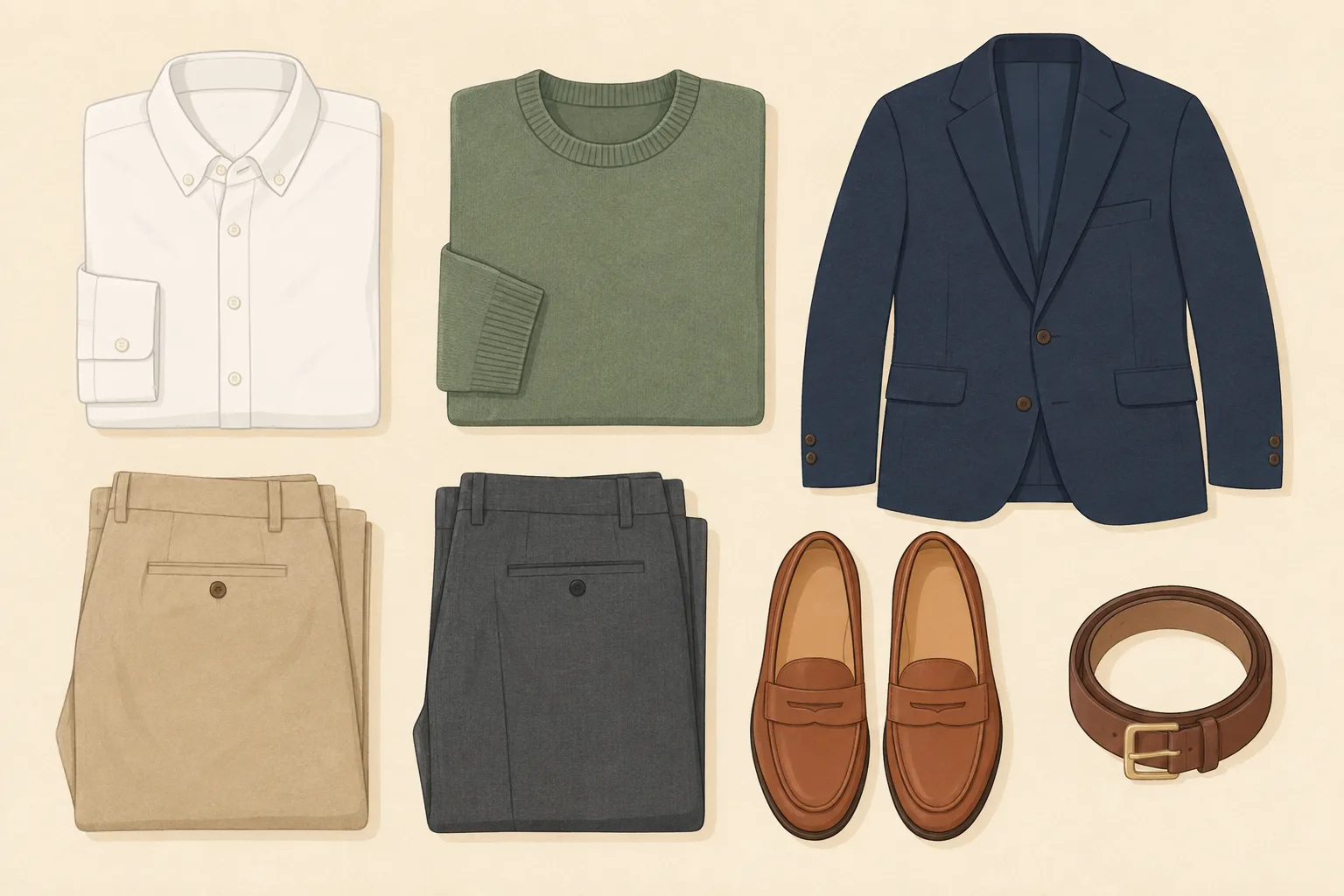
You do not need a new work wardrobe. You need roughly a dozen pieces that combine with each other, most of which you may already own.
- Two or three bottoms: chinos in a neutral, tailored trousers in navy or grey, and dark jeans or a midi skirt depending on your office.
- Four or five tops: two shirts or blouses, one or two fine knits, and one polo or smart tee.
- One jacket: an unstructured blazer in navy or grey is the single most useful piece, because it lifts anything underneath it by a full tier.
- Two pairs of shoes: one leather (loafers, derbies, boots or low heels) and one clean minimal trainer, if your office allows it.
Keep everything within the same few neutrals and every top works with every bottom. Four tops and three bottoms already give you twelve outfits before the jacket doubles them. That is the same logic as a capsule wardrobe, applied to five days a week.
The last step is deciding in advance. Business casual is exactly the kind of dress code that eats a morning, because there are just enough options to hesitate over. Planning the week's outfits the night before, or on a Sunday, takes the decision out of the rush.
Let your wardrobe answer the question
The hard part of business casual is not knowing the rules. It is looking at your own clothes at 7:40 in the morning and seeing which combinations clear the bar.
That is what Closet DJ does. Once your wardrobe is in the app, the outfit generator builds complete looks from what you already own. Tell the Style Assistant it is a client day, or that your office is fairly relaxed, and it adjusts: jacket in, trainers out, or the other way round. Because it tracks what you actually wear, it also notices when you have worn the same shirt three Mondays running and suggests the one you forgot about.
Frequently asked questions
What is considered business casual attire?
Clothing between a suit and weekend wear: tailored trousers or chinos, collared shirts, blouses, fine knitwear, smart skirts or dresses, optional blazers, and leather shoes or clean minimal trainers. It excludes athletic wear, shorts, graphic tees, flip flops and ripped denim.
Are jeans business casual?
In many offices, yes, if they are dark, clean, well fitting and free of rips or fading, and worn with a smart top or jacket. In smarter workplaces such as law, finance or client facing roles, they usually are not. Check what people one level above you wear before assuming.
Can you wear sneakers for business casual?
Often, as long as they are plain leather or suede trainers in white, black or a neutral, kept clean and paired with smart trousers and a collared or knit top. Running shoes and chunky athletic trainers do not count.
What is the difference between business casual and smart casual?
Business casual is a workplace dress code and leans slightly more formal, often expecting collared tops and tailored trousers. Smart casual is broader and social, covering dinners and events, and allows more freedom with jeans, colour and footwear. In practice the two overlap heavily, and many offices use them interchangeably.
Stop guessing what passes at work. Closet DJ turns the clothes you already own into business casual outfits for the whole week. Try it free.
Ready to remix your closet?
Try Closet DJ free. Organise your wardrobe and let AI build outfits from what you already own.
Recevez les nouveaux articles par e-mail
Un e-mail par nouvel article, écrit par l'équipe Closet DJ. Pas de spam, désabonnement à tout moment.